December 20, 2014 - Carmen replies to a photo from "La page de Maître Zen" shared by Liliana Catanoiu:"Thank you, Liliana. I love Zen Spirit ! To see in the little things the great miracles. Happy Sunday!"
March 21, 2014 - Ravi Chandrasekhar (Carmen's avatar) shared Zen music on Carmen's timeline, with the comment "Un sedativ fara contraindicatii" (relaxing pill without contraindications)
February 12, 2015 - Ravi Chandrasekhar (Carmen's avatar) shared "Zen and Quantum Psysics with Vincent Keisen Vuillemin and Andrei Dorobanțu" with the mention "A serious gift on Valentine's Day"
Dupa 8 ani. In vara lui 2013 am avut ocazia sa petrec suficient de mult timp, in Ploiesti, in discutii (inedite) cu sora mea Carmen,
ca sa imi dea (after the fact) un sentiment de "closure".
A fost o
persoana paradoxala. Complicata. Pe facebook avea 5 personas, cu care ocazional purta polemici (ca dialog intre centre diverse din interiorul ei).
A avut parte de tragism in exces (partial
self-inflicted, partial datorat contextului/sansei - in pofida ideilor
"pozitive" ce le enunta periodic ca sa-si dea curaj), insa a biruit
fortele ce o trageau in jos (sau in directii ce nu erau potrivite cu
firea ei intima) printr-o abundenta de creativitate a spiritului sau estetic.
Carmen a fost fiecare din acestia. Fiecare dintre ei era ea.
She and them - the quintuple - were her immediate society.
Given the circumstances of her life, this multiplication (leading to situations in which she polemicized with herself) could be seen as sad, or could be seen as an existential literary plot-play.
Carmen lived more than 24 years under the communism. She was born on July 3, 1965 and died at 49, at roughly the same age as Rosario Castellanos, who so powerfully wrote about cultural and gender oppression.
Carmen was an introverted spirit - that's for sure. But when somebody got her started, she would eloquently spoke for hours engaging in sophisticated arguments - mostly academic, but sometimes with highly practical overtones that got herself surprised. After the fact, I find this passionate speeches reflected a deep sadness.
At an adolescent age, she incorporated a sublimated eroticism of an imaginary friend (whose name I will not divulge) into short prose and poetry. This later developed into a strong affinity with the dynamic stories of Krishna and Radha. And yes she loved James Dean, fact which may be correlated with her adventures in the Gothic realm.
She made the mistake of showing her early writings to Matilda Caragiu-Marioteanu, who behaved in a dismissive and rude manner (speaking of gender oppressing like gender). The argument that both Carmen and Matilda were strong, opinionated characters (so... whatever!) does not hold water, since the "debate" between a child and a high-rank academic is uneven: the child always loses and marked forever by the rejection. So it's still oppressive. And Carmen learned her lesson every time somebody behaved dismissively towards her: learning her lesson meant she became more and more introverted, sometimes going to the extreme of creating an imaginary universe in which she felt safe and appreciated.
Carmen's destiny was textbook case of gender oppression, her potential and talent being willingly and unwillingly inhibited by societal cliches, interest groups in her fields (Indian literature and Philosophy, Esthetics, etc.), and yes, even the family caught in their own projects and dreams (notable exception - the moment she decided - and ultimately got the family's blessing - to switch from a Math/Physics school to a school in Languages). While that was a reprieve, she continued to be subjected to gender oppression. She faced everything with bravery, but never stood a chance - what could she do before 1989? Or even later? Like previously noted, she peacefully immersed herself deeper and deeper in an imaginary universe. Life truly became art! But everything was not OK.
To be clear, the church - through dogma and cult - in which she actually did not participate, was part of the problem. She hated religious fundamentalists. More than that, citing Jaspers, considered as absurd the claims that church attendance, baptism and communion were necessary conditions for salvation (these were actually mainstream). Adding insult to injury, she was fascinated by gender fluidity! The fact that some of her writings have - at places - soft, charming philosophical eastern orthodox overtones (in a style of artistic confessions, not surprisingly similar to - and adaptations of - the wonderful style of her explorations of the Indian esthetic thought and yoga) is, sadly, explainable by a necessity to pay a sort of "protection/cohabitation tax" to the paternalistic centers of the religious power (unfortunately with tentacles extended everywhere in Romania), hoping for a social truce or compromise that would preserve her own identity reflected in the spirit of her art, esthetics and theory. Therein lies a new danger to which she was subjected both before and after her death: cultural appropriation. In many respects it has been done (and will continue), but these notes represent the beginning of a long overdue duty of mine to push back.
But now, after years, the truth is that my dear Goth is free in her own esthetic Mahāparinirvāṇa (esthetic being the key word here, that is beyond the tentacles of organized religion and in perpetual enjoyment of the "deep field" network of beauty, music and love) and I became an Agnostic (with a touch of mindfulness). A sort of convergence.
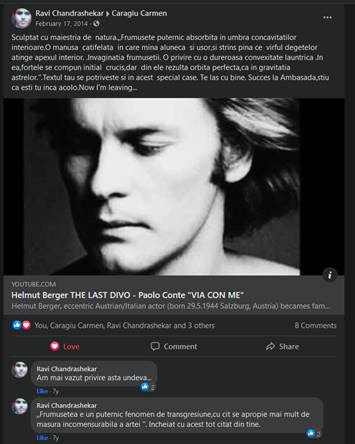
On February 17, 2014, commenting on Visconti's Ludwig, Carmen wrote on how...
art and gender fluidity have potentiated the typical aesthetic fascination with gender transgression (trans-gender)
the religious moral dogma of gender purity somewhat severed the spontaneity of artistic inspiration
in art you can talk about anything, since in art everything is understood differently
seriously ignorant on the mysteries of art, ideologue preachers caught in a moralizing mania put out diluted discourses about love, sex and marriage and place art in bed of Procrustes, demonizing gender fluidity on the grounds that the force of ambivalent suggestion can tempt man (yet the Gospel's spirit of implies that he who is not tempted will not live)
as beauty gets closer to the ineffable essence of art, it gets accompanied by the phenomena of transgression seen as trans-gender horizon.
"Filmul
Ludwig este o capodopera a lui Visconti si o mare reusita
interpretativa a lui Helmut Berger, in rolul principal. Homosexualitatea
lui Visconti si bisexualitatea lui Berger n-au nimic de-a face cu
judecata de valoare artistica. In nici un caz nu o infirma. Dimpotriva,
as zice, a potentat fascinatia tipic estetica a transgresiunii
genurilor. Lectura biologica a transgresiunii poate potenta, dar nu este
identica cu lectura suprabiologica a transgresiunii, tipic estetica.
Mutatiile ,,tropice'', definitorii pentru figurile de stil, sunt un
arhetip imaginar vag al mutatiei de gen sau al ambiguizarii genului.
Crestinismul cu dogma sa morala a puritatii genurilor a cam retezat din
temelii spontaneitatea inspiratiei artistice, asta-i sigur. Realitatea
este ca in arta poti sa vorbesti despre orice, pentru ca aici totul se
lasa inteles ALTFEL. Ideologia crestina grav ignoranta in ceea ce
priveste misterele artei interzice acest lucru, pe motiv ca...FORTA
SUGESTIEI AMBIVALENTE poate ispiti omul. Nimic mai penibil . Cine nu va
fi ispitit nu va trai, afirma pe de alta parte Evanghelia. Cele mai
diluate discursuri despre iubire, sex, casatorie le intilnim la prostii
predicatori crestini, cei care schingiuiesc arta asezind-o in Patul lui
Procust care e mania moralizatoare. Dezambiguizarea morala devenita un
TIC MALADIV actioneaza aici ca o caracatita ucigasa ce a prins in
tentaculele ei fiinta vie si fecunda a ambiguitatii estetice."
``Deci. Dl.Ravi ma provoaca la o discutie filozofica. De la ce porneste totul? De la faptul ca un mutual friend, nu importa numele, o persoana cu talente si cu o inteligenta deosebite, a indraznit sa critice sistematic matrapazlicurile clericilor, cunoscute de toata lumea. Aceeasi persoana, probabil exasperata de atitudinea fariseilor noi, a comis un gest retoric si si-a autoaplicat eticheta de antiteist.Altfel spus, a calcat cu stingul apasat si ce-i drept,a facut sa sara citiva stropi pe cei ce s-au nimerit sa-i fie in preajma,indivizi cam simandicosi...Colegul meu Ravi stia bine ca prietenul nostru comun e o fiinta deschisa la minte,cu o viziune superioara asupra transcendentei, si ca aceasta eticheta pe care si-a pus-o singur e doar un consemn,o licenta de stil, un mod mai strident de a atrage atentia asupra deraparilor grave ale institutiei bisericesti. Bineinteles, antiteismul e in sine un termen nepotrivit, pentru ca nu Dumnezeu e de vina pentru scaderile oamenilor. El e VICTIMA, ca de obicei. Asadar, Ravi vine si il invoca pe Jaspers numai pentru a-l pune la punct pe amicul comun. Aduce in discutie ideea de dialog constructiv,elaborata de filozoful german. Acesta a spus,insa :Dialogul e ceva sacru. Nu se poate dialoga pe un substrat de ipocrizie. Apoi, acelasi Ravi trimite, in mod tendentios,spre ideea de transcendenta imbratisata de Jaspers. Uitind sa mentioneze, insa, ca Jaspers s-a pronuntat categoric impotriva ideii de conditionare a credintei de ritual. A fost impotriva bisericii ca institutie de localizare si garantare a transcendentei, cum insusi a spus. Adica, i s-a parut o nerozie sa afirme cineva ca daca nu mergi la biserica si nu te impartasesti nu te mintuiesti. Ar insemna, de aici, ca 99 la suta din oameni sa mearga in iad. De aceea am refuzat categoric orice dialog filozofic pe acest substrat aluziv si ipocrit. Multi dintre barbati vor sa-si manifeste superioritatea si puterea in orice conditii. Din nefericire pentru ei, mai exista si intuitia femeii...Gata.'' (7 Februarie 2014)
On February 25, 2015, Carmen shared a link pertaining to another central (albeit, sadly, her best kept secret from the public for various reasons, on which I will elaborate later), interest of her - Indian Philosophy (after all her Thesis was basically at the interface between Esthetics and Indian thought).
A reader loved this particular passage:
'Shiva’s
trishul represents the three fundamental aspects of life. These are the
three fundamental dimensions of life that are symbolized in many ways.
They can also be calledIda, Pingala and Sushumna. These are the three
basic nadis – the left, the right and the central – in the pranamaya
kosha, or the energy body of the human system. Nadis are pathways or
channels of prana in the system. There are 72,000 nadis that spring from
the three fundamental ones.
The
Pingala and Ida represent the basic duality in the existence. It is
this duality which we traditionally personify as Shiva and Shakti. You
can simply call it masculine and feminine. When I say masculine and
feminine, I am not talking in terms of sex – about being male or female –
but in terms of certain qualities in nature. You could say the logical
and the intuitive aspect of you.'
Further in discussion: "Fiziologia mistica indiana, fundamentul practicii yoga,dar si al tantrismului sivait."
Below I present her last uploaded picture - that was on February 25, 2015 (less than 2 months before her passing), followed by her two book recommendations (a few months after my visit to Romania, when we discussed at length about her views on Twin Peaks). Of course every such `archaeology' is incomplete - human beings are of course incredibly complex.
I though of a self-assessment in the Schrodinger cat form, where the dead/alive cat gets pair gets replaced by a believer/agnostic pair (as Toma Caragiu was, and with high probability, Carmen as well).
Now I am moving more towards an agnostic/atheist pair (with a mindfulness added flavor), and an increased awareness that the reality under the "believer" category (whatever that is, if any) is very different from what most people usually believe or expect without questioning.
In fact this represents rather well the substance and philosophical tone of my discussions with Carmen in the Summer of 2013, in Ploiesti. It was very interesting, and at some moment will be back with an account.
Since her passing, some concerted effort was made to "benevolently" forge her image as somebody totally committed to the orthodox dogma in the highest sense (which was far from the truth), going as far as burying her (who did not believe in the usual "mandatory sacraments") in a monastery. Knowing her, that's a gross cultural appropriation at a minimum.
There is a lot to discover about Carmen, since she was a complex figure (in no case 1D). In any case, approximating reality after the fact is hard.