“The idea of the sacred is quite simply one of the most conservative notions in any culture, because it seeks to turn other ideas - uncertainty, progress, change - into crimes.”
Salman Rushdie, “Is nothing sacred?”, Penguin (Non-Classics),1990

Professor of Mathematics, Ohio Northern University (retired). Experimental Mathematics. Physics passionate. Mindfulness is agnostic. Views are my own.
“The idea of the sacred is quite simply one of the most conservative notions in any culture, because it seeks to turn other ideas - uncertainty, progress, change - into crimes.”
Salman Rushdie, “Is nothing sacred?”, Penguin (Non-Classics),1990

From the RECORDER investigative journalist:
"after 8 months of undercover investigation I discovered a secret network in which businessmen, politicians and prelates from the top of the Church work hand in hand in a mega-business: the construction and rehabilitation of churches with public money. All this network operates with the blessing of the most powerful person in the Romanian Orthodox Church, whom his people call the Great White"
On February 17, 2014, commenting on Visconti's Ludwig, Carmen wrote on how...
"Filmul Ludwig este o capodopera a lui Visconti si o mare reusita interpretativa a lui Helmut Berger, in rolul principal. Homosexualitatea lui Visconti si bisexualitatea lui Berger n-au nimic de-a face cu judecata de valoare artistica. In nici un caz nu o infirma. Dimpotriva, as zice, a potentat fascinatia tipic estetica a transgresiunii genurilor. Lectura biologica a transgresiunii poate potenta, dar nu este identica cu lectura suprabiologica a transgresiunii, tipic estetica. Mutatiile ,,tropice'', definitorii pentru figurile de stil, sunt un arhetip imaginar vag al mutatiei de gen sau al ambiguizarii genului. Crestinismul cu dogma sa morala a puritatii genurilor a cam retezat din temelii spontaneitatea inspiratiei artistice, asta-i sigur. Realitatea este ca in arta poti sa vorbesti despre orice, pentru ca aici totul se lasa inteles ALTFEL. Ideologia crestina grav ignoranta in ceea ce priveste misterele artei interzice acest lucru, pe motiv ca...FORTA SUGESTIEI AMBIVALENTE poate ispiti omul. Nimic mai penibil . Cine nu va fi ispitit nu va trai, afirma pe de alta parte Evanghelia. Cele mai diluate discursuri despre iubire, sex, casatorie le intilnim la prostii predicatori crestini, cei care schingiuiesc arta asezind-o in Patul lui Procust care e mania moralizatoare. Dezambiguizarea morala devenita un TIC MALADIV actioneaza aici ca o caracatita ucigasa ce a prins in tentaculele ei fiinta vie si fecunda a ambiguitatii estetice."
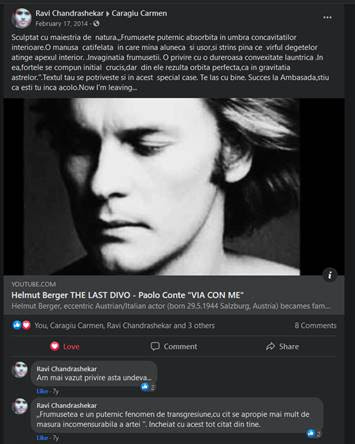

I though of a self-assessment in the Schrodinger cat form, where the dead/alive cat gets pair gets replaced by a believer/agnostic pair (as Toma Caragiu was, and with high probability, Carmen as well).
Now I am moving more towards an agnostic/atheist pair (with a mindfulness added flavor), and an increased awareness that the reality under the "believer" category (whatever that is, if any) is very different from what most people usually believe or expect without questioning.
In fact this represents rather well the substance and philosophical tone of my discussions with Carmen in the Summer of 2013, in Ploiesti. It was very interesting, and at some moment will be back with an account.
Since her passing, some concerted effort was made to "benevolently" forge her image as somebody totally committed to the orthodox dogma in the highest sense (which was far from the truth), going as far as burying her (who did not believe in the usual "mandatory sacraments") in a monastery. Knowing her, that's a gross cultural appropriation at a minimum.There is a lot to discover about Carmen, since she was a complex figure (in no case 1D). In any case, approximating reality after the fact is hard.