Showing posts with label math. Show all posts

April 15, 2026

Math chalkboards and mandalas...

There is a quiet, almost ceremonial moment at the end of a mathematics lecture that often goes unnoticed. After an hour of careful construction—definitions laid down, computations layered, structures revealed—the chalkboard stands filled to its edges with meaning. Every line is deliberate. Every symbol carries weight. And yet, in a matter of seconds, it all disappears beneath the sweep of an eraser.

What remains is not the board, but the understanding.

Your analogy to the Tibetan mandala captures something profound about this act. In the creation of a mandala, monks spend hours or days placing colored grains of sand with extraordinary precision, forming intricate geometric patterns that symbolize the universe. The work is patient, disciplined, and deeply meaningful. Yet, upon completion, the mandala is not preserved. It is dismantled—its grains brushed away, often returned to a river—embodying the principle of impermanence.

So too with the chalkboard.

In presenting a mathematical theory, the dense writing, the multiple perspectives, the unfolding of structure, these form a kind of intellectual mandala. Each method illuminates the same underlying reality from a different angle, much like the symmetries within a mandala reflect a deeper order. The mathematical chalkboard, filled to capacity, becomes a temporary universe of thought.

And then it is erased.

This erasure is not loss. It is, in a sense, completion. The purpose of the work was never the chalk marks themselves, just as the mandala was never meant to endure as an object. Both are vehicles—means through which understanding, insight, or contemplation arises. Once that purpose is fulfilled, attachment to the physical form becomes unnecessary, even contrary to the spirit of the practice.

There is also humility in this act. Mathematics, for all its precision and permanence as a discipline, is practiced in moments that are fleeting. The lecture ends, the board is cleared, and the space is made ready for new ideas. What persists is carried internally: in memory, in intuition, in the quiet restructuring of thought that follows a deep encounter with a problem.
In this way, the mathematician at the chalkboard and the monk creating a mandala share a common gesture. Both engage in acts of careful creation that culminate not in preservation, but in release. And in that release, there is a recognition: the true substance of their work lies not in what is seen, but in what is understood.

May 9, 2025

The Math Pontiff

Pope Leo XIV earned a BS in Mathematics from Villanova University in 1977. 

Interesting.

December 4, 2024

Memories - a beautiful campus and an abstract - 27 years ago

I vividly remember that talk. 

People were great! Added bonus: the campus and the nature were amazing. 

I could recover my abstract from https://scholarworks.umt.edu/mathcolloquia/7/


So... about 27 years years ago:


Presentation Date 10-23-1997 

Abstract A classical problem considered by Davenport asks for the number of occurrences of a certain pattern of quadratic residues and nonresidues among the set of integers modulo a prime p. We will take this problem as a starting point of an itinerary revealing the interplay between quasirandom structures over finite fields, definable subsets of finite fields, character sums and coding theory. 

Additional Details Thursday, October 23, 1997 4:10 p.m. in MA 109 Coffee/Tea/Treats 3:30 p.m. in MA 104 (Lounge)

October 26, 2024

Are these the same proof?

In his blog, Timothy Gowers presents two proofs of the fact that the product of k consecutive positive integers is a multiple of k! and asks  

"whether there is some sophisticated perspective from which it is possible to regard them as sort of the same"

There are many interesting answers from the readers, among them being Terence Tao.


October 14, 2024

My book among the best 20 prime numbers books of all time (10/10/2024)

As of October 10, I noticed that Sequential Experiments with Primes is ranked 6th in the list of best 20 prime numbers books of all time (maintained by bookauthority - here). 

The evaluations in the rubrics New Mathematical Ideas and High Impact Learning make me happy because these were the primary objectives and the spirit in which I wrote the book.

July 3, 2024

With Fifth Busy Beaver, Researchers Approach Computation’s Limits (Quanta Magazine)

Turing Machines


With Fifth Busy Beaver, Researchers Approach Computation’s Limits

After decades of uncertainty, a motley team of programmers has proved precisely how complicated simple computer programs can get.

QUANTA MAGAZINE - https://www.quantamagazine.org/amateur-mathematicians-find-fifth-busy-beaver-turing-machine-20240702/

June 24, 2024

AI Will Become Mathematicians’ ‘Co-Pilot’

AI Will Become Mathematicians’ ‘Co-Pilot’ 

Fields Medalist Terence Tao explains how proof checkers and AI programs are dramatically changing mathematics 

By Christoph Drösser - https://www.scientificamerican.com/article/ai-will-become-mathematicians-co-pilot/ (June 8, 2024)

March 23, 2024

February 7, 2024

130 years of mind games and quantum challenges

 A wonderful article by Laurie Wurth-Pressel (source)

130 years of mind games and quantum challenges

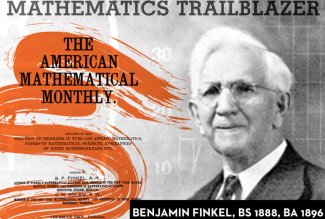
graphic showing Benjamin Finkel, a mathematic trailblazer

2024 marks the 130th anniversary of The American Mathematical Monthly. 

The trailblazer who launched this premier academic journal in 1894 and inspired the establishment of the American Mathematical Association (AMA) graduated from Ohio Northern University in the late 1800s—Benjamin Franklin Finkel, BS 1888, BA 1896.

Mathematical problems fascinated Finkel from a young age, and his eagerness to solve them impelled his ambition to “publish a journal devoted solely to mathematics and suitable to the needs of teachers of mathematics.”

He once stated: “Many dormant minds have been aroused into activity through the mastery of a single problem.” 

Over a century later, Finkel’s statement still rings true. 

While much has changed at Ohio Northern since Finkel’s days, the University continues to attract brilliant problem-solvers molded in Finkel’s character who graduate to become leading mathematicians and physicists. 

Read about three outstanding alumni from ONU’s School of Science, Technology, and Mathematics, housed in the Getty College of Arts & Sciences, who are making a mark in the world of physics and mathematics.
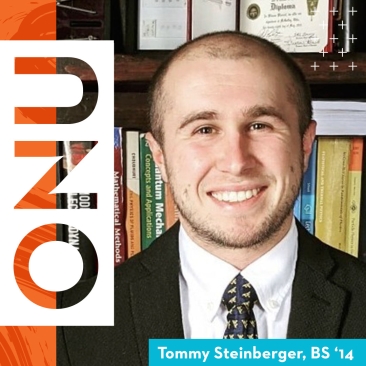
Photo of Tommy SteinbergerFrom algebra to plasma physics

Thomas (Tommy) Steinberger, BS ’14, Ph.D., is breaking new ground in experimental plasma physics at West Virginia University in Morgantown, W.V.

A research assistant professor in the Department of Physics and Astronomy, he explores charged gas systems (plasmas), investigating gas particle motion and temperature. His work aims to enhance electronics manufacturing, space travel, and our understanding of space phenomena, such as magnetic reconnection.

“I come into the lab and can work on 10 different projects before lunch,” he said. “I have a lot of ongoing projects that are unique. Most of my effort is helping all these projects move forward.”

Steinberger’s journey began in freshman Algebra class in high school. While his classmates bellyached about having to solve 50 of the 100 algebra problems listed in the final exam, he felt a burst of excitement.

 “I completed nearly all 100 in a couple of days, almost obsessively,” he recalled. 

His ONU experience further ignited his passion for problem solving. He joined ONU-SOLVE, a problem-solving group of students that tackle the challenging problems found in leading math magazines such as Fibonacci Quarterly, Mathematics Magazine, The College Mathematics Journal, and Finkel’s own The American Mathematical Monthly.

ONU-SOLVE has been recognized multiple times in recent years for submitting correct solutions, and several have been published in leading journals as the most well-written solutions, according to Mihai Caragiu, Ph.D., professor of mathematics.

According to Steinberger, several solutions he worked on with the assistance of ONU professors received honorable mentions in academic magazines.

“My time at ONU really fostered my interest in math and its application to other fields,” he said. “I received fantastic instruction from professors who truly cared about their students.” 

After graduating from ONU with a double major in mathematics and physics, and minor in astronomy, Steinberger received a master’s degree in physics and astronomy, and a Ph.D. in experimental plasma physics from West Virginia University. 

“The challenge of the subjects (math and physics) resonates with my stubborn nature,” he added. “It leads me to be ever more persistent in my studies.”

Photo of Ashley ErnstFrom jigsaw mastery to national defense

Ashley Ernst, BS ’15, Ph.D., is a senior physicist at Arcfield in Colorado Springs, Colo, where she helps to solve complex challenges in support of the United States’ most critical national security missions.

Arcfield is a leading provider of mission-focused systems engineering and integration capabilities to the U.S. Intelligence Community, Department of Defense, and other agencies.

Ernst is currently working primarily with simulation and modeling of radiation in both vacuum and in atmosphere or material. She develops technical documentation, presents work to clients, and performs calculations with the aid of software.

“There is always another problem on the horizon,” she says. “The quest for the solution to the next problem is what drives me every day.”

Growing up, Ernst loved to solve jigsaw puzzles with her mom. As her skill increased, so did her hunger for harder challenges.

“They became larger in puzzle number, smaller in puzzle piece size, and more complex in shape and design,” she said. “When that wasn’t enough, I started solving puzzles without guide pictures.”

When she first arrived at ONU, however, she lacked focus and felt extremely homesick. Her ONU professors noticed her struggles and made special efforts to engage her in math conferences and ONU-SOLVE. Professor Caragiu spurred her mind into action by exposing her to Graph Theory and Discrete mathematics.

“Having a direction for my mental energy definitely helped me,” she said.

Within a short time, she says, she was on a better path forward. “I would not be where I am today without their help. The math and physics programs at ONU nurture the search for knowledge. No matter the level, the program meets the student at that level and pushes them to the next level.”

After graduating from ONU with a double major in physics and applied mathematics, Ernst earned a master’s degree in physics and a Ph.D. in hadronic physics from Florida State University. Her second year of graduate school, she received a highly-competitive National Science Foundation (NSF) Graduate Research Fellowship, which she credits to the quality of education and one-on-one mentoring she received at ONU.

“Each student that passes through the math program at ONU is instilled with a sense of excitement regarding a problem. While that problem may change, that excitement stays,” she said. 
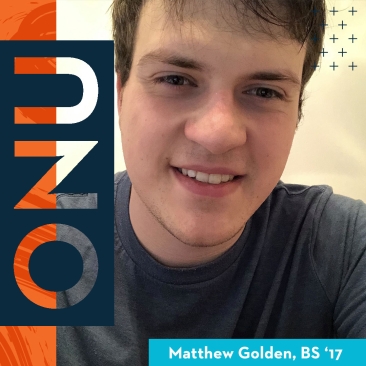
Photo of Matthew GoldenFrom twisty puzzles to cosmic enigmas

Matthew Golden, BS ’17, Ph.D., is a postdoctoral fellow at the Georgia Institute of Technology in the Xtreme Astrophysics group. The group is led by two founding members of the Event Horizon Telescope Collaboration, which released the first image of a black hole in 2019.

“I am a full-time researcher,” he said. “My research focuses on the interface of machine learning and physics. Specifically, I work on using machine learning to accelerate human learning. Our goal is to produce physics equations directly from complex data with minimal human intervention.” His recent publication in Science Advances showed how machine learning learned the equations of a living fluid directly from a video of the experiment.

In high school, Golden became enthralled with solving “twisty puzzles”—think Rubik’s cube, only the more complicated versions. He had puzzles of every platonic solid and with hundreds of pieces. Some would take him mere minutes to solve, others weeks.

“I eventually went on to solve the four-dimensional 3x3x3x3 Rubik’s cube,” he said. “You can find my name in the 4D Hall of Fame as solver #196.”

At ONU, his obsession switched to General Relativity. He spent many late nights in the Mathile Center for the Natural Sciences working through derivations. Then, he’d head to the third floor of Heterick Memorial Library, pull a random math or physics book from the shelf, and read until he was “hopelessly confused.” 

“My schooling was significantly accelerated compared to the usual undergraduate,” he said. “That’s because the physics department was small and the teachers eager to teach at any pace.”

His professors allowed him to take courses in any order he desired. He completed Quantum Mechanics his first semester, then continued to grow his knowledge in leaps and bounds. He’ll never forget being the only student in Dr. Khristo Boyadzhiev’s Real Analysis class. Dr. Boyadzhiev, who obtained YouTube fame for his consistent classroom outfit and greeting, passed away in June 2023.

“It feels like half the people my age know Dr. Khristo Boyadzhiev because of his lovable appearance on Vine,” said Golden. “He was a micro celebrity, and I still remember him laughing about it in the hall.”

Golden also recalls leading a small group of students to first place in the 2017 Ohio MAA Leo Schneider Team Math Competition, dethroning Case Western Reserve University for the first time in many years. 

With accelerated learning and one-on-one attention, Golden says he was way ahead of his peers in graduate school. 

“The education I received was passionate and tailored to me,” he said. “There is no math program in the Midwest that could compete with the personal attention I received at ONU, and it paid off.”

He’s ecstatic that his professional career is centered on gravity research.

“I love that every day I get to think about machine learning and extreme astrophysical environments,” he said. “I get to interact with some of the greatest minds in physics.”

January 8, 2024

The poetry of recursion

After teaching what I believe to be the highest-numbered MATH class in the catalogue (MATH 4671 Probability and Graphs - a.k.a. Random Graphs - a quite difficult class), next year 2024-2025 I would like to take at step towards the other end of the spectrum, and teach Mathematics for Liberal Arts (MATH 1201). 

It will be a challenge. 

I want to get into the mindset of a poet, and I want to make said poet feel a friendly spirit in the abstract realm. That would be difficult indeed.

For that I need a guiding theme, a guiding spirit - and I found it: the poetry of recursion

December 20, 2023

Many thanks and gratitude to my students!

At the end of every semester, I find myself amazed, impressed, and grateful seeing amazingly uplifting comments from my students. This gives me the power to move on. Some excerpts from evaluations for my Discrete Mathematics class - Fall 2023:

"I think this course is a great introduction to higher level math, its related language, terminology, as well as higher-level working logic. I enjoyed this class as it dove into many of the mysterious, hidden patterns that I have seen in math for several years. It is interesting to learn all of these things and finally learn the "secrets" behind math."


"The materials in discrete math reminded me a lot of the materials in the digital logic class I took the semester prior. I enjoy all things math and I also enjoyed that digital logic class as well. It was nice to be able to build upon that knowledge and become more familiar with the theory behind topics such as k-maps, modules, and decryption. Decryption and it's multiple theories was one topic that I think interested me the most."


November 7, 2023

42+ years later - Kozyrev-Grinberg for my students


In one of my classes, this past week we discussed Kozyrev-Grinberg theory (for me it brought back ideas that I felt passionate about 42 years ago - it felt good to resuscitate them, and my students apparently liked it).

June 28, 2023

Dr. Khristo Boyadzhiev (September 4, 1948 - June 28, 2023) - in memoriam


Dear colleagues,

It is with deep sadness that I inform you of the death of our colleague and friend, Emeritus Prof. Dr. Khristo Boyadzhiev, who passed away last night after battling a prolonged illness.

With a Ph.D. in Mathematics from the University of Sofia, Bulgaria in 1978, Khristo came to ONU in 1990 and has been a Professor of Mathematics since 2000.

During his years at ONU he was the heart and intellectual power engine of our small Mathematics community, whether the Mathematics and Statistics Department and lately the Mathematics Program.

Khristo was a prolific researcher. He has more than 98 publications, and published three books in the prestigious World Scientific (“Notes on the Binomial Transform” – 2018 and “Special Techniques for Solving Integrals” – 2022).

He served ONU for an impressive number of years: 32 years of teaching, from 1990 to 2022.

Among his professional recognitions while an ONU faculty, one can mention:

* The 2013 Carl B. Allendoerfer Award (national recognition granted by the Mathematical Association of America – MAA) for the article “Close Encounters with the Stirling Numbers of the Second Kind” - Mathematics Magazine, Vol. 85, no. 4, October 2012, 252-266).
* Mary Reichelderfer Chair in Mathematics for 2013-2014, 2006-2007, 1995-1996, 1994-1995, and 1993-1994.
* Faculty Research and Scholarship Award: Recognition of Achievement – 2019
* ONU Summer Research Stipend – 2014
* Presented numerous conference talks, and gave 7 invited talks.
* Recognized more than 40 times for his excellent solutions sent to mainstream Mathematics journals such as American Mathematical Monthly, Mathematics Magazine, College Mathematics Journal, and Fibonacci Quarterly. Moreover 8 of his solutions have been featured by publication in the respective journals.
* Khristo initiated the Mathematics Seminar at ONU and he was the Seminar coordinator for many years. The Seminar was, and continues to be, one of the central mathematical activities at ONU, and will be forever linked to the name of Khristo Boyadzhiev.

For all his activity and kind spirit, Khristo will be greatly missed.
 
He will remain forever in our hearts!
 
Mihai Caragiu, ONU Mathematics Program Lead


November 14, 2022

Yitang Zhang - the genius who prevailed

Pe scurt - viata unui geniu matematic - Yitang Zhang - care a suferit multe obstacole, faultari si a trecut prin multe perioade dificile. Sint foarte bucuros ca a reusit.

https://en.wikipedia.org/wiki/Yitang_Zhang

Zhang's PhD work was on the Jacobian conjecture. After graduation, Zhang had trouble finding an academic position. In a 2013 interview with Nautilus magazine, Zhang said he did not get a job after graduation. "During that period it was difficult to find a job in academics. That was a job market problem. Also, my advisor [Tzuong-Tsieng Moh] did not write me letters of recommendation." Zhang made this claim again in George Csicsery's documentary film "Counting from Infinity: Yitang Zhang and the Twin Prime Conjecture" while discussing his difficulties at Purdue and in the years that followed. Moh claimed that Zhang never came back to him requesting recommendation letters. In a detailed profile published in The New Yorker magazine in February 2015, Alec Wilkinson wrote Zhang "parted unhappily" with Moh, and that Zhang "left Purdue without Moh's support, and, having published no papers, was unable to find an academic job". In 2018, responding to reports of his treatment of Zhang, Moh posted an update on his website. Moh wrote that Zhang "failed miserably" in proving Jacobian conjecture, "never published any paper on algebraic geometry" after leaving Purdue, and "wasted 7 years of his [Zhang's] own life and my [Moh's] time". After some years, Zhang managed to find a position as a lecturer at the University of New Hampshire, where he was hired by Kenneth Appel in 1999. Prior to getting back to academia, he worked for several years as an accountant and a delivery worker for a New York City restaurant. He also worked in a motel in Kentucky and in a Subway sandwich shop. A profile published in the Quanta Magazine reports that Zhang used to live in his car during the initial job-hunting days. He served as lecturer at UNH from 1999 until around January 2014, when UNH appointed him to a full professorship as a result of his breakthrough on prime numbers. Zhang stayed for a semester at The Institute For Advanced Study in Princeton, NJ in 2014, and he joined the University of California, Santa Barbara in fall 2015.

October 23, 2022

QUANTA MAGAZINE: Mathematicians Discover the Fibonacci Numbers Hiding in Strange Spaces

Mathematicians Discover the Fibonacci Numbers Hiding in Strange Spaces 

Recent explorations of unique geometric worlds reveal perplexing patterns, including the Fibonacci sequence and the golden ratio.

Read the Quanta Magazine paper here.

July 5, 2022

Ukrainian mathematician gets Fields medal

BREAKING: Maryna Viazovska, a Ukrainian sphere-packing number theorist, has been awarded the Fields Medal, math’s highest honor. She is the second woman to receive the medal in its 86-year history

QUANTA MAGAZINE: In Times of Scarcity, War and Peace, a Ukrainian Finds the Magic in Math